Symbiosis Entrance Exam for Design (SEED) is the entrance examination for undergraduate design admissions at Symbiosis Institute of Design (SID), Pune. The examination assesses candidates’ visual sensitivity, observation, reasoning, problem-solving and design aptitude.
Students seeking admission to SID’s Bachelor of Design (B.Des) programme must appear for SEED and complete the subsequent selection process.
Which Programme Requires SEED?
Symbiosis Institute of Design (SID), Pune, offers a four-year Bachelor of Design (B.Des) programme comprising 160 credits.
The first year provides a foundation in essential design concepts and skills. Students subsequently pursue one of seven specialisations:
- Graphic Design
- Animation and Film Design
- User Experience Design
- Product Design
- Interior Space Design
- Fashion Design
- Fashion Communication
Students should explore the curriculum and career opportunities associated with each specialisation before selecting their preferred discipline.
What Is SEED?
The Symbiosis Entrance Exam for Design (SEED) is conducted for admission to the undergraduate B.Des programme at Symbiosis Institute of Design, Pune.
Unlike examinations that primarily assess subject knowledge, SEED evaluates abilities relevant to design education, including creativity, visual perception, observation, logical reasoning and problem-solving.
The examination is conducted online, with candidates required to follow the instructions issued by SID for the relevant admission cycle.
Who Can Apply for SEED 2027?
Candidates must meet the eligibility requirements prescribed by SID for admission to its B.Des programme.
- Educational qualification: Candidates must have passed Class 12 (10+2) or an equivalent examination, or completed a D.Voc qualification in the same or an allied sector.
- Minimum marks: Candidates must have secured at least 45% aggregate marks in the qualifying examination, or 40% for candidates belonging to the applicable reserved categories.
- Students awaiting results: Candidates appearing for their Class 12 or eligible diploma examinations may also apply, subject to SID’s conditions regarding the declaration of results.
Students from Science, Commerce and Humanities backgrounds are eligible to apply, provided they meet the prescribed requirements.
Candidates should also review the official eligibility and documentation guidelines before applying, particularly if they have completed their qualifying examination through an international board or hold qualifications requiring an equivalence certificate.
What Is the SEED Exam Pattern?
SEED is an online examination designed to evaluate a candidate’s aptitude for design.
Exam Component | Details |
Exam name | Symbiosis Entrance Exam for Design (SEED) |
Duration | 60 minutes |
Number of questions | 60 |
Total marks | 60 |
Question formats | Multiple-choice, matching, fill-in-the-blanks, image-based and comprehension-based questions |
Negative marking | No |
Mode | Online |
What Skills Does SEED Assess?
SEED evaluates creative and analytical abilities relevant to design education. The areas covered include:
Visual sensitivity and judgement: Understanding shapes, colours, patterns and visual compositions.
- Observation and perception: Identifying details, relationships and visual information.
- Logical reasoning: Recognising patterns, analysing information and drawing conclusions.
- Problem-solving: Applying creative and analytical thinking to different situations.
- Art, craft and culture: Awareness of artistic traditions, cultural influences and design.
- Design and the environment: Understanding the relationship between design, everyday life and the surrounding environment.
- Basic science and mathematics: Applying foundational concepts and logical thinking.
How Should You Prepare for SEED?
Preparation for SEED should focus on strengthening observation, reasoning and design aptitude rather than relying exclusively on memorisation.
1. Practise with sample papers
Solve the official SEED sample papers to familiarise yourself with question formats and identify areas requiring improvement.
2. Develop visual observation
Examine everyday objects, buildings, advertisements and digital interfaces. Consider their purpose, visual arrangement, usability and design choices.
3. Strengthen logical reasoning
Practise pattern recognition, spatial reasoning, visual sequences and analytical questions to improve accuracy and problem-solving speed.
4. Explore art, craft and culture
Develop awareness of Indian art, traditional crafts, design movements and contemporary visual culture.
5. Practise under timed conditions
With 60 questions to answer in 60 minutes, time management is important. Practise completing sample papers within the prescribed duration.
What Should Your Design Portfolio Include?
A design portfolio should showcase your strongest work while demonstrating creativity, technical skills, personal interests and your approach to problem-solving.
SID advises candidates to compile their best work, highlighting their skills, interests and experience across different techniques.
Your portfolio may include:
- Sketches, drawings, illustrations and photography.
- Graphic design, posters, digital artwork and visual storytelling.
- Product concepts, models and prototypes.
- Fashion, textile and craft projects.
- Personal creative projects demonstrating experimentation and originality.
Choose work that reflects your interests and abilities rather than simply including as many projects as possible.
What Is the Admission Process After SEED?
Appearing for SEED is mandatory for Indian students seeking admission to SID’s B.Des programme. However, performance in the entrance examination alone does not guarantee admission.
The selection process includes the following stages:
- Registration: Complete the online SEED registration and application process.
- Entrance examination: Appear for SEED on the scheduled date.
- Result and shortlisting: Check the examination result and subsequent selection announcements.
- Portfolio submission: Upload your portfolio according to SID’s instructions.
- Portfolio Review and Personal Interaction (PRPI): Participate in the prescribed evaluation process.
- Merit list and admission: Check the final selection outcome and complete the admission formalities if selected.
Candidates should follow the official admission schedule for the applicable deadlines and instructions.
SEED 2027: Important Dates and Timeline
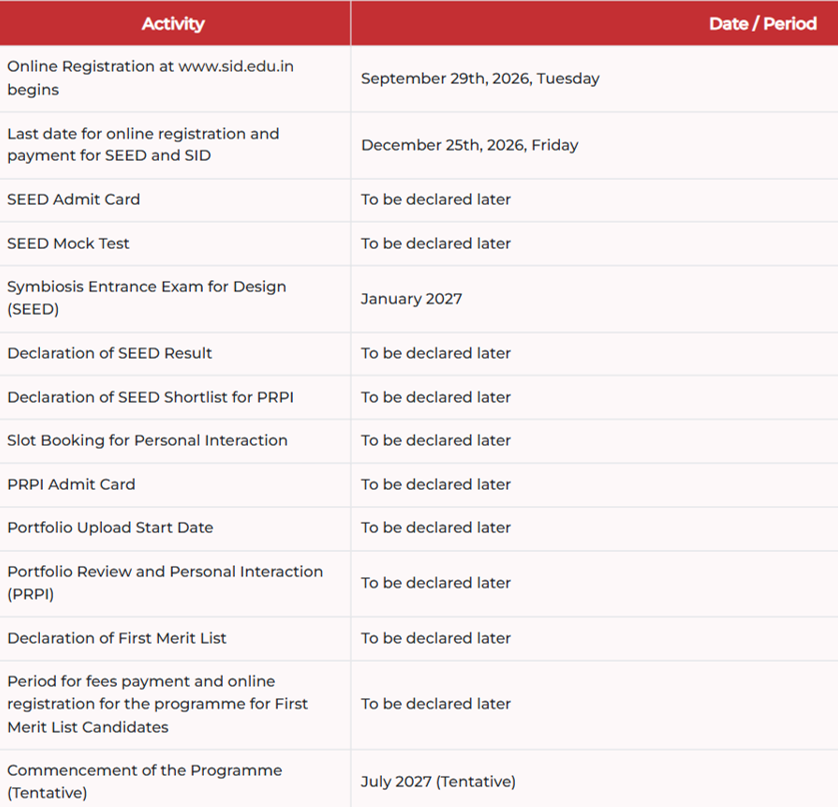
Source: Symbiosis Institute of Design
Ready to Take the Next Step Towards a Career in Design?
SEED is an opportunity for students interested in pursuing design to demonstrate their creativity, observation and problem-solving abilities. Understanding the examination pattern, preparing strategically and building a portfolio that reflects your strengths can help you approach the admission process with confidence.
Planning to apply for SEED 2027? Complete your registration by 25th December 2026.