
JEE has its roots in the IIT-JEE, which began in 1961. The All India Engineering Entrance Examination (AIEEE) was introduced in 2002 for NITs and central institutions. In 2013, both were restructured under the unified JEE framework, splitting the examination into two tiers: JEE Main (Stage 1) and JEE Advanced (Stage 2).
JEE Main
JEE Main is the first stage of the JEE examination, conducted by the National Testing Agency (NTA). It serves a dual purpose: qualifying candidates for JEE Advanced, and acting as a standalone entrance examination for admission to NITs, IIITs, GFTIs, and numerous state-level and private engineering colleges across India.
| Feature | Detail |
| Conducting Body | National Testing Agency (NTA) |
| Frequency | Twice a year — Session 1 (January) & Session 2 (April) |
| Mode | Computer-Based Test (CBT). Drawing section in Paper 2A is offline. |
| Duration | 3 hours per session |
| Language | 13 languages: English, Hindi, Assamese, Bengali, Gujarati, Kannada, Malayalam, Marathi, Odia, Punjabi, Tamil, Telugu, Urdu |
| Official Website | jeemain.nta.nic.in |
Key Features of JEE Mains
- Eligibility: Open to students who have passed or are appearing for their Class 12 exams. Students can attempt the exam up to three consecutive years after completing their Class 12.
- Frequency: Conducted twice a year (January and April), offering students two opportunities to improve their scores.
- Question Type: The question paper comprises multiple-choice questions (MCQs) and numerical value-based questions.
- Marking Scheme: For MCQs, 4 marks are awarded for each correct answer, while 1 mark is deducted for each incorrect answer. There is no negative marking for numerical value-based questions.
- Paper Types:
- Paper 1: For B.E./B.Tech aspirants (consists of three subjects — Physics, Chemistry, and Mathematics, carries equal weightage- 100 marks)
- Paper 2A & 2B: For B.Arch and B.Planning aspirants (400 marks).
Important Dates 2026 (JEE Main)
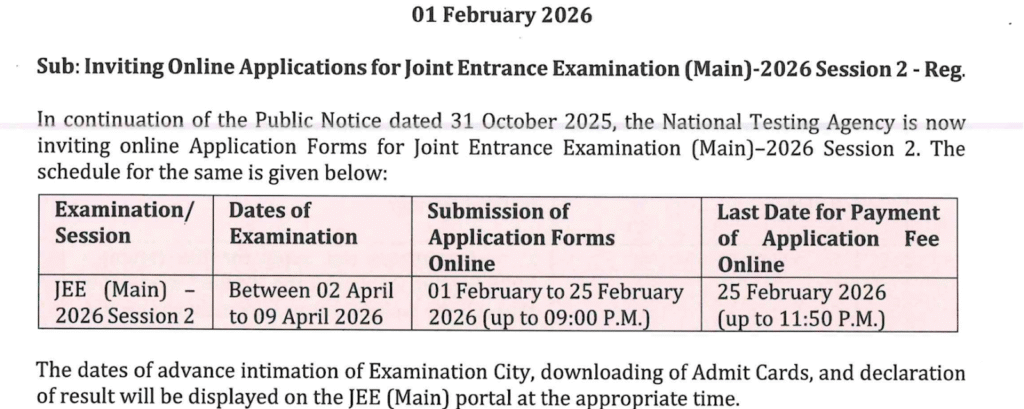
Source: NTA
JEE Advanced
JEE Advanced is the second stage of the JEE system and is the sole gateway to the 23 Indian Institutes of Technology (IITs). It is widely regarded as one of the most challenging undergraduate entrance examinations in the world.
JEE Advanced is conducted by one of the seven zone IITs (IIT Bombay, Delhi, Guwahati, Kanpur, Kharagpur, Madras, Roorkee) on a rotational basis. JEE Advanced 2026 will be organized by IIT Roorkee. In addition to IITs, a good JEE Advanced rank can secure admission to IISc Bangalore and IISERs.
Key Features of JEE Advanced 2026
- Eligibility: Top 2,50,000 (approx.) candidates of JEE Mains are eligible to appear for JEE Advanced. Additional eligibility criteria include age restrictions and a maximum of two attempts in consecutive years.
- Age Limit: Candidates should have been born on or after October 1, 2001. Five years age relaxation is given to SC, ST, and PwD candidates, i.e. these candidates should have been born on or after October 1, 1996.
- Number of attempts: A candidate can attempt JEE (Advanced) maximum of two times in two consecutive years.
- Appearance in Class 12 exam: A candidate should have appeared for the Class XII (or equivalent) examination for the first time in either 2025 or 2026 with Physics, Chemistry, and Mathematics as compulsory subjects.
- Duration: The exam duration is 3 hours for each paper.
- Sections: JEE Advanced consists of two papers – Paper 1 and Paper 2. Each paper is further divided into three sections – Physics, Chemistry, and Mathematics.
- Question Type: The question paper comprises multiple-choice questions, numerical value-based questions, and matrix match type questions.
- Marking Scheme: The marking scheme for JEE Advanced varies for different question types. It is essential for students to understand the specific marking scheme for each question type.
To access question papers from the last 3 years, click here.
Important Dates 2026 (JEE Advanced)
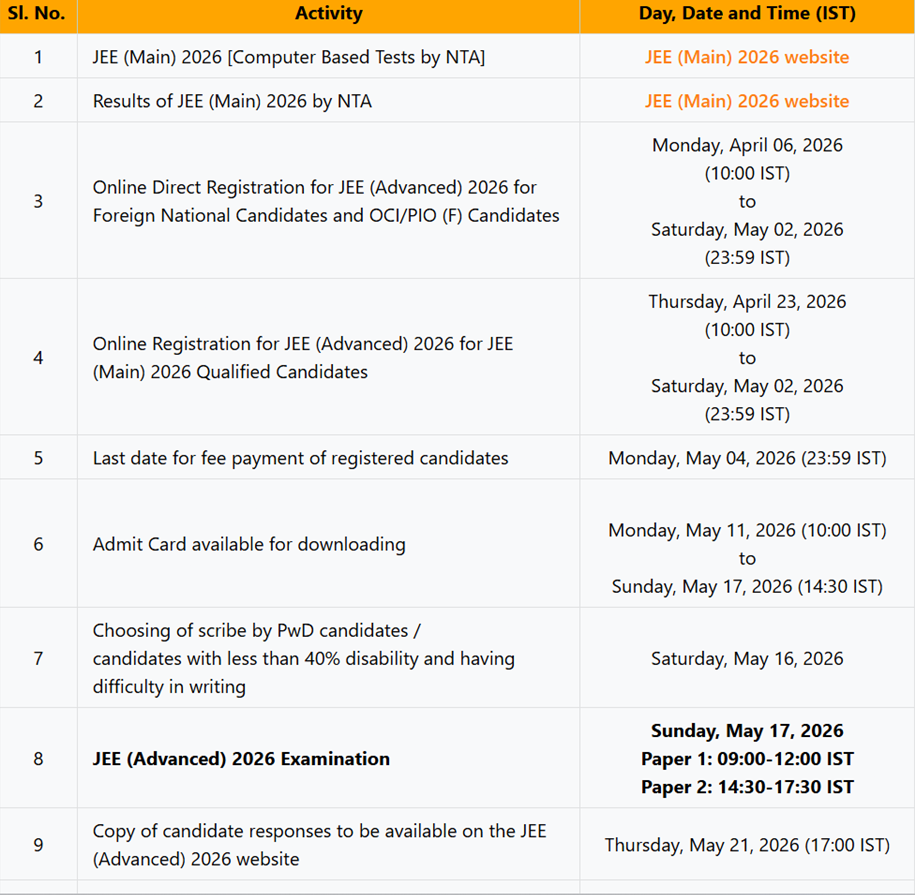
Source: IIT Roorkee
Fee Structure
JEE Main:
- Male candidates (Unreserved/EWS/OBC category): INR 1,000.
- Female candidates: INR 800.
- SC/ST/PwD/Transgender category: INR 500.
JEE Advanced:
- Female candidates (All categories), SC, ST & PwD: INR 1,600.
- All other candidates: INR 3,200.
JEE Main Counseling
- Seat allocation for IITs, NITs, IIITs, and other centrally funded technical institutions (GFTIs) is done through the Joint Seat Allocation Authority (JoSAA). JoSAA typically conducts 6–7 rounds of allotment.
- Steps involved in JEE Mains counselling through JoSAA Counselling are:
- Step 1: Online Registration
- Step 2: Choice Filling and Locking
- Step 3: JoSAA Seat Allotment
- Step 4: Seat Acceptance, Document Verification and Fee
- Step 5: Reporting to the Allotted Institute
Conclusion
JEE remains one of the most transformative examinations a student can pursue in India. While the competition is fierce, a strong JEE Main performance opens doors to excellent institutions across the country, from NITs and IIITs to top private universities.
Registration for Session 2 is currently open, don’t miss your chance to take the next step toward JEE success. Apply today!