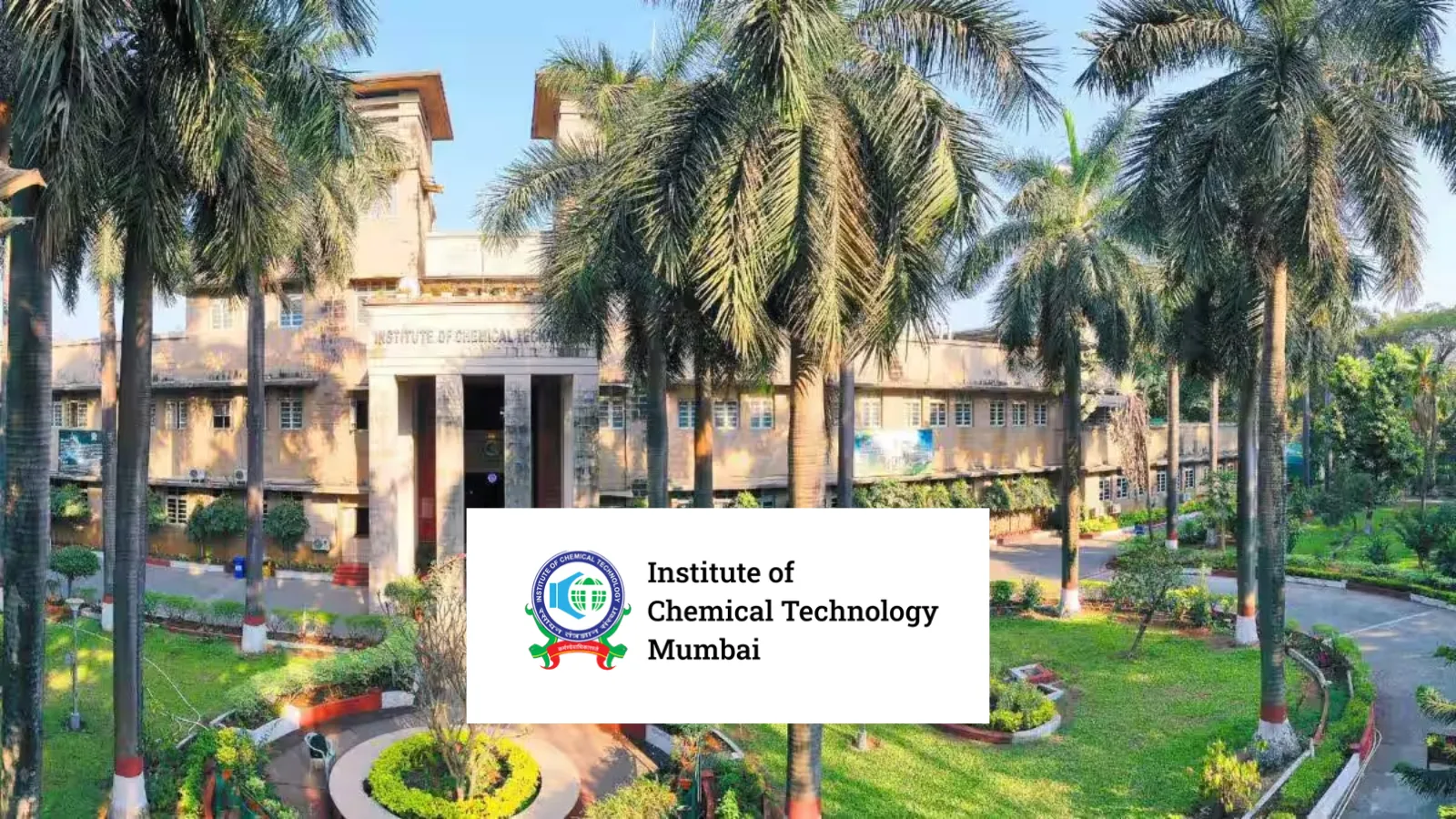
Established on October 1, 1933, as the University Department of Chemical Technology (UDCT) under the University of Bombay (now the University of Mumbai), the Institute of Chemical Technology (ICT), Mumbai was founded with the vision of strengthening India’s capabilities in chemical science and technology.
Introduction
The institute’s academic independence grew steadily. UDCT was granted partial autonomy in 1985, followed by enhanced autonomy under the framework promoted by the University Grants Commission (UGC). Due to its size and spread of activities, it was converted into University Institute of Chemical Technology (UICT) on 26th January, 2002 and under the TEQIP of the World Bank it was granted full autonomy in 2004.
Following a rigorous peer-review process by the UGC, ICT was formally conferred the status of a Deemed-to-be University by the Ministry of Human Resource Development, Government of India, on 12 September 2008.
Campuses
ICT Mumbai operates across three official campuses:
- Mumbai (Main Campus): The original and principal campus, housing the core academic departments and research facilities.
- ICT-IOC Bhubaneswar Campus: A satellite campus established in collaboration with IndianOil, located in Odisha.
- ICT Marathwada Campus, Jalna: An off-campus centre in Maharashtra offering select academic programmes.
Undergrad Programs
ICT Mumbai offers highly specialised 4 year undergraduate programmes designed to meet industry and research demands:
- B. Chem. Engg. (Bachelor of Chemical Engineering)
- B. Tech. in Food Engineering and Technology
- B. Tech. in Oils, Oleochemicals and Surfactants Technology
- B. Tech. in Polymer Engineering and Technology
- B. Tech. in Surface Coating Technology
- B. Tech. in Dyestuff Technology
- B. Tech. in Fibres and Textile Processing Technology
- B. Tech. in Pharmaceutical Chemistry and Technology
- B. Pharm.
Admissions Process
Admissions to all undergraduate programmes at ICT Mumbai are conducted through the Government of Maharashtra via the State Common Entrance Test Cell (www.mahacet.org).
The admission process is managed through the Centralized Admission Process (CAP). Candidates must complete all registration, counselling, and choice-filling steps online via the official portal, which redirects to cetcell.mahacet.org. Seat allotment is based on entrance exam performance, eligibility criteria, and CAP rounds conducted by the state authority.
Conclusion
If you’re seeking a rigorous, industry-aligned education in chemical and applied sciences, ICT Mumbai deserves a place at the top of your preference list! The institute has produced leaders across industry, science, and research including Mukesh Ambani (Chairman of Reliance Industries), R A Mashelkar and Man Mohan Sharma (both Fellows of the Royal Society), Ashwin Dani (Non-Executive Vice Chairman of Asian Paints), and K. Anji Reddy (founder of Dr. Reddy’s Laboratories).
Registrations for MAH CET are currently open. Aspiring applicants should regularly check the official MAH-CET and CET Cell portals for entrance exam notifications, CAP schedules, and eligibility updates to ensure they don’t miss key admission milestones.