
Introduction
The careers today’s students will enter may look very different from the jobs their parents started their careers in. AI, digital transformation, demographic shifts, and sustainability are reshaping industries worldwide.
The World Economic Forum’s Future of Jobs Report 2025 offers one of the clearest pictures of this shift. It’s based on responses from over 1,000 employers representing more than 14 million workers across 55 economies, making it one of the most comprehensive surveys of its kind. So what does it mean for high school students preparing for university?
According to the WEF, these are the 10 skills expected to grow most rapidly in importance by 2030:
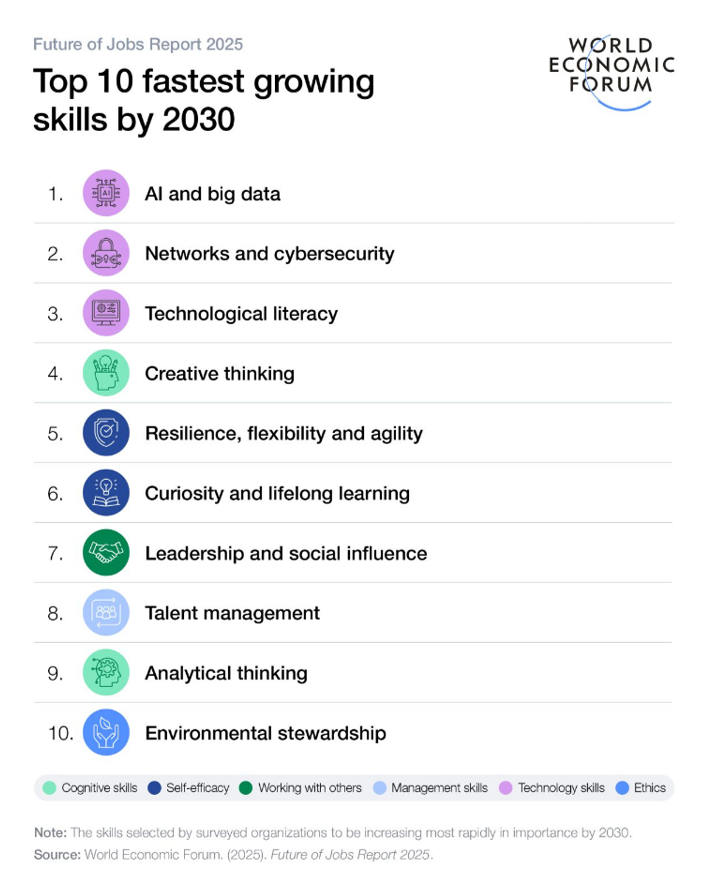
The list is interesting because it combines technical skills with human skills. Employers are not simply looking for students who know how to use technology, but they also value creativity, adaptability, leadership and the ability to keep learning.
What Does This Mean for Students
- Technology touches every career. AI, data, and cybersecurity fill three of the top ten spots. Whether a student wants to study engineering, medicine, business, law, psychology or the humanities, digital confidence is becoming increasingly important. That’s why universities are weaving AI and digital tools into courses well beyond computer science, a shift also flagged in the Microsoft Work Trend Index and Coursera Global Skills Report.
Students don’t need to wait for university to catch up — a free intro course on Coursera, edX, or Google’s own AI courses is an easy place to start.
- Human skills aren’t going away. Creative thinking, leadership, analytical thinking and communication remain highly valued because these are difficult to automate. Many universities already encourage students to build these skills through research projects, presentations, teamwork, internships and extracurricular activities.
Debate, Model UN, the school newspaper, or a student-run club build exactly these skills, often more effectively than a classroom can.
- Learning doesn’t stop after school. One of the most important skills on the WEF list is Curiosity and Lifelong Learning. As industries evolve, professionals will need to continuously update their knowledge. This makes learning how to learn just as important as what you learn. The LinkedIn Workplace Learning Report makes the same point: continuous learning is now a top priority for organizations.
A simple way to build this habit early is to follow one industry or field outside the school syllabus — a newsletter, podcast, documentary or YouTube channel works just as well as a course.
- Sustainability is now a workforce skill. Environmental Stewardship entering the top ten shows growing demand for people who understand sustainability across sectors, not only environmental science but also business, engineering, architecture, finance and public policy.
Getting involved in an eco-club, a sustainability project, or even a small school-level initiative counts as real, relevant experience.
What Are Universities Looking For?
The skills highlighted by the WEF and other workforce reports are not only relevant once students enter the workplace. They are also skills that students can begin developing and demonstrating during their school years.
Depending on the university and programme, admissions teams may look for evidence of:
- Intellectual curiosity and critical thinking – through challenging coursework, independent reading or exploring questions beyond the syllabus.
- Initiative and creativity – through personal projects, competitions, clubs or activities a student has taken the lead in.
- Problem-solving and collaboration – through research, team projects and community initiatives.
- Resilience and adaptability – demonstrated through how students respond to challenges and learn from setbacks.
- Research and project experience – through academic research, experiments, extended projects or other hands-on experiences.
- Digital confidence and responsible AI use – including the ability to use technology thoughtfully, evaluate information critically and understand its limitations.
The takeaway? Students don’t need to check every box. What matters is developing genuine interests and using opportunities at school and beyond to explore them in depth.
It’s Not Just the WEF saying this
The WEF is not alone in identifying these trends. Other major reports point in a similar direction:
| Report | What it emphasises |
| LinkedIn Workplace Learning Report | Continuous learning and adaptability |
| Microsoft Work Trend Index | AI literacy and human-AI collaboration |
| Coursera Global Skills Report | Digital, AI and data skills |
| McKinsey Future of Work | Cognitive, technological and social-emotional skills |
| Deloitte Global Human Capital Trends | Leadership, adaptability and human capabilities |
Conclusion
No one knows exactly what the job market will look like in 2035. But one thing is clear: students who can learn, adapt, think critically and use technology responsibly will be better prepared for whatever comes next.
Start today by building strong academic foundations, exploring beyond the syllabus, developing communication and collaboration skills, and staying curious about how careers are changing. You don’t need to predict the future, you need to be ready to learn your way into it.