
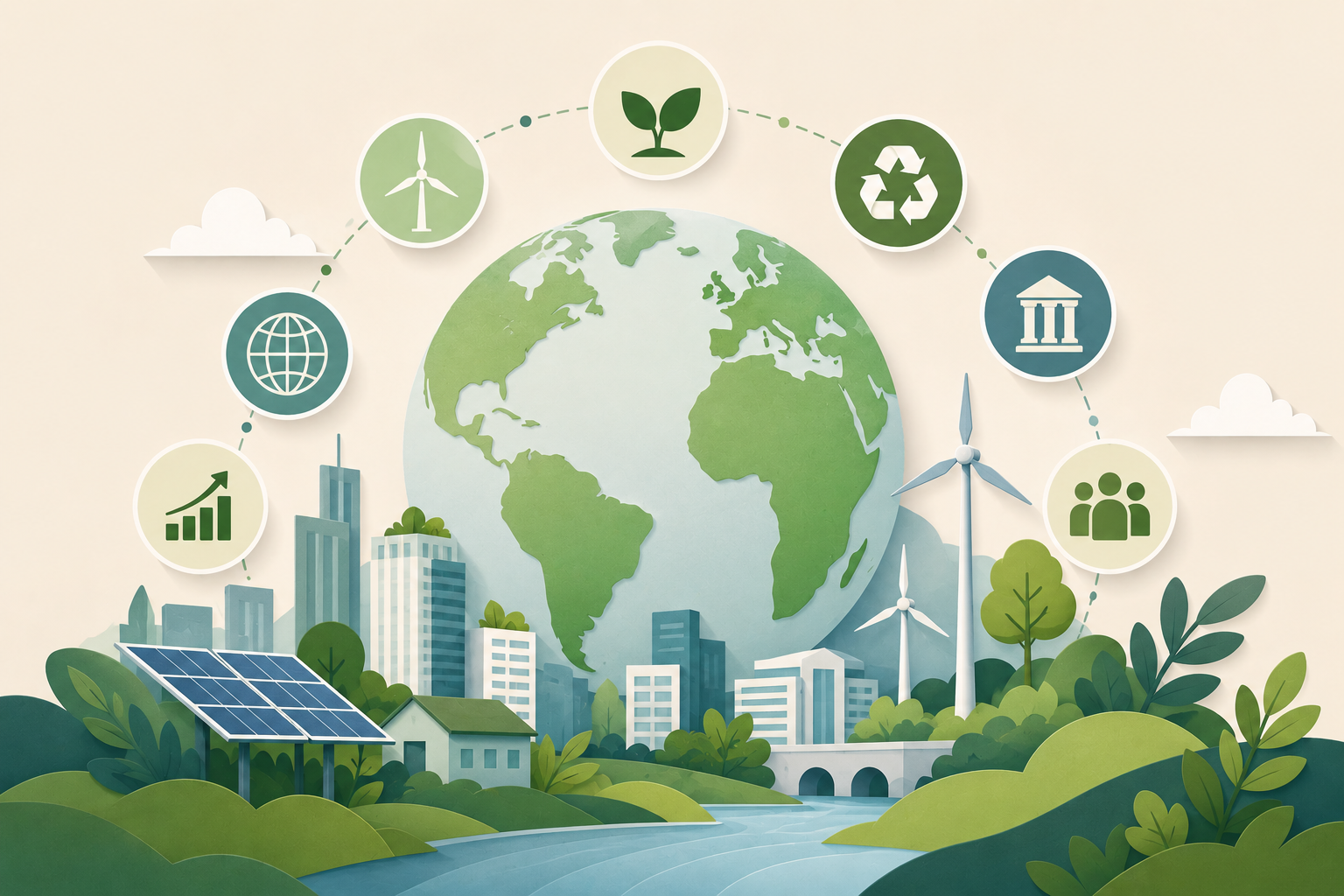
For high school students planning their higher education and future careers, the climate, sustainability, and ESG sector represents one of the fastest-growing and most resilient employment markets of the coming decades.
Introduction
The definition of a future-ready career is undergoing a fundamental shift. Choosing a career path has traditionally meant selecting from established fields such as engineering, medicine, finance, or law. Today, however, global challenges are creating entirely new career opportunities. Climate change, resource scarcity, clean energy, sustainable business practices, and environmental responsibility have become priorities for governments, companies, investors, and communities worldwide.
According to the International Labour Organization (ILO), the transition to a greener economy could create 24 million new jobs globally by 2030, provided the right policies are in place. Businesses are under increasing pressure to reduce emissions, manage resources responsibly, and improve transparency around their environmental and social impact. Governments are strengthening climate policies, investors are evaluating companies based on sustainability performance, and consumers are increasingly choosing environmentally responsible brands.
For today’s students, this means that careers focused on sustainability are no longer niche, they are becoming mainstream across multiple industries.
Why are Climate, Sustainability, and ESG Careers Growing?
Environmental conservation was once largely associated with non-profit organisations and scientific research. Today, sustainability has become a core business priority. Companies across sectors are integrating sustainability into their long-term strategies.
Although the terms are often used together, they have distinct meanings:
| Climate Change | Sustainability | ESG |
| Focuses on reducing greenhouse gas emissions and adapting to climate change | Focuses on balancing environmental, social, and economic impact for long-term development | Measures how organisations perform on Environmental, Social, and Governance parameters |
| Includes renewable energy, carbon management, and climate resilience | Covers efficient resource use, waste reduction, circular economy, and responsible operations | Used by investors, regulators, and companies to assess sustainability performance |
| Often driven by national and international climate commitments | Applies to everyday organisational practices | Increasingly required through reporting and disclosure regulations |
India is also at the centre of this global transition. The country has committed to achieving net-zero emissions by 2070, while significantly expanding renewable energy, electric mobility, green hydrogen, and sustainable infrastructure. These initiatives are expected to generate substantial employment opportunities across multiple sectors.
Career Opportunities in the Green Economy
One of the biggest strengths of this sector is its diversity. Students from Science, Commerce, and Humanities backgrounds can all find meaningful career pathways.
1. Renewable Energy
Renewable energy powers the green economy through solar, wind, green hydrogen, battery storage, and smart grids. Students interested in physics, engineering, electrical systems, or technology design may find this field particularly rewarding.
Example roles:
- Solar Engineer
- Wind Energy Engineer
- Energy Storage Specialist
- Renewable Energy Project Manager
- Government and Regulatory Officer
2. Corporate ESG and Sustainability
Most large organisations now measure and report their environmental and social performance. Professionals in this area help companies collect sustainability data, prepare ESG reports, assess risks, and meet regulatory requirements. This area suits students who enjoy business, research, data analysis, and communication.
Example roles:
- ESG Analyst
- Sustainability Consultant
- Sustainability Reporting Associate
- Carbon Accounting Specialist
3. Climate Finance and Carbon Markets
Climate finance combines sustainability with economics, investment, and public policy. Governments and businesses require professionals who can finance green projects and evaluate climate-related risks. It is suitable for students interested in economics, finance, commerce, mathematics, or statistics.
Example roles:
- Climate Risk Analyst
- Green Bond Analyst
- Carbon Market Specialist
- Sustainable Investment Analyst
4. Clean Mobility and Electric Vehicles
The transition towards electric vehicles is creating opportunities across engineering, battery technology, charging infrastructure, manufacturing, and software. The field is ideal for students interested in automobiles, robotics, electronics, or computer science.
Example roles:
- Battery Systems Engineer
- EV Infrastructure Planner
- Supply Chain Specialist
- Electric Mobility Consultant
5. Sustainable Agriculture and Circular Economy
This field focuses on producing more with fewer resources while reducing waste and improving resource efficiency. Students interested in biology, environmental science, agriculture, or data analytics may find exciting opportunities here.
Example roles:
- Precision Agriculture Specialist
- Waste Management Consultant
- Circular Economy Analyst
- Organic Certification Consultant
6. Green Architecture and Urban Planning
Future cities need buildings that consume less energy, conserve water, and remain resilient to climate change. Students interested in architecture, geography, design, or civil engineering can explore this field.
Example roles:
- Sustainable Building Designer
- Urban Climate Planner
- Green Building Consultant
- Green Certification Auditor
Degrees and Study Pathways
Students can enter the sustainability sector through a variety of undergraduate programmes. Please note that the degree programmes listed below are not exhaustive.
| Career Interest | Possible Degrees |
| Renewable Energy | B.Tech in Electrical, Mechanical, Energy, or Chemical Engineering |
| Climate Science | B.Sc. Environmental Science, Earth Science, Atmospheric Science |
| ESG and Sustainability | BBA, B.Com., Economics, Environmental Management |
| Climate Finance | Economics, Finance, Commerce, Business Analytics |
| Public Policy | Political Science, Public Policy, Law |
| Sustainable Cities | Architecture, Urban Planning, Geography, Civil Engineering |
Many professionals later specialise through postgraduate programmes in sustainability, climate policy, renewable energy, environmental management, or ESG. Explore different programmes, majors, and minors offered by universities to find a pathway that aligns with your interests and career goals.
Conclusion
Climate, sustainability, and ESG careers are no longer limited to environmental organisations. They are expanding rapidly across industries including energy, finance, consulting, manufacturing, agriculture, technology, urban planning, and public policy.
For high school students, this presents an exciting opportunity to explore the field. You can:
- Learn about concepts such as carbon footprint, net zero, biodiversity, circular economy, and sustainable development.
- Take free introductory courses on climate science, sustainability, or ESG.
- Participate in climate competitions, youth summits, or environmental projects organised by institutions such as TERI or WWF-India.
- Follow organisations and professionals working in renewable energy, sustainability, and climate policy.
- Speak with professionals working in the green economy to understand different career pathways.
As the world transitions towards a greener future, those who develop the right knowledge and skills today will be well placed to shape the careers of tomorrow.