Introduction
For international students, choosing Germany means more than earning a respected degree. It means entering a higher education system known for academic strength, research opportunities, and close links with industry. Germany also offers a wide range of institutions and programmes, from research-focused universities to practice-oriented universities of applied sciences.
The country is becoming particularly popular among Indian students. According to the latest figures from the German Academic Exchange Service (DAAD), 69,816 Indian students were enrolled at German higher education institutions in the winter semester 2025/26, an increase of 17.5% from the previous year. Indians now form the largest international student group in Germany.
This growth reflects Germany’s appeal as a study destination, particularly for students interested in engineering, technology, science, research and other fields with strong links to the country’s economy.
Germany is one of Europe’s leading economies and a major centre for research, engineering, technology and industry.
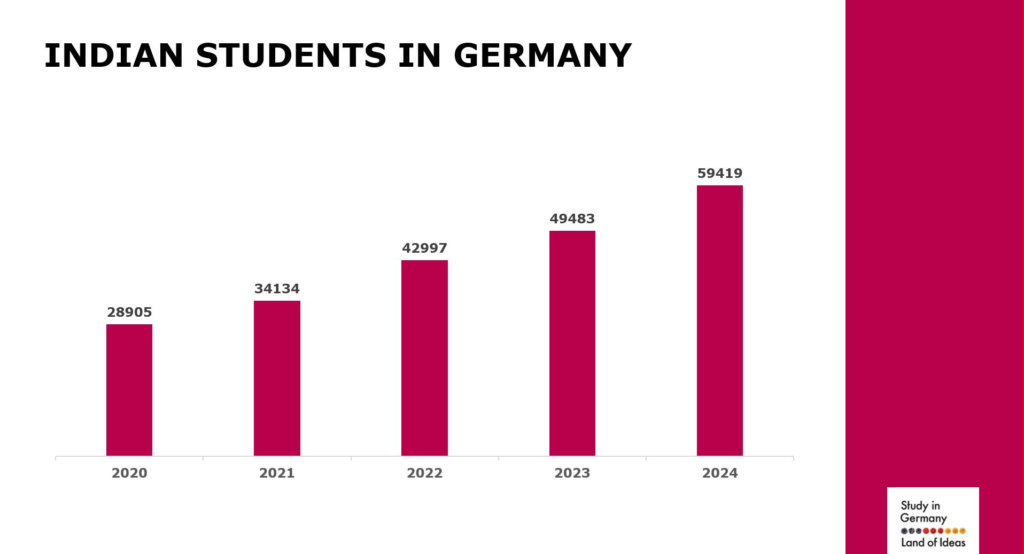
Source: DAAD
Types of Universities in Germany
Germany’s higher education landscape is diverse, catering to a wide range of academic and professional goals. Universities are broadly divided into public and private institutions, with public universities forming the backbone of the system.
Higher education institutions are divided into:
- Universities (Universitäten): Universities in Germany often have the broadest range of academic programs and research opportunities leading to bachelor’s, master’s, and doctoral degrees. These institutions also have a stronger emphasis on research and theoretical knowledge, in all types of fields ranging from humanities to natural sciences, health and medicine, law, information science, and more. There are also technical universities (Technische Universitäten – TU), which award all levels of degrees with a focus on engineering and scientific subjects.
- Colleges of Art, Music and Film (Kunst, Musik-und Filmhochschule): These are specialized institutions for students who want to pursue studies in one of these fields. They offer bachelor’s and master’s degrees, sometimes even PhD programs in fields such as fine arts, design, architecture, music, theater, dance, etc.
- Universities of Education (Pädagogische Hochschulen): These universities specialize in teacher training programs. They offer bachelor’s and master’s degree programs (some can even award doctoral degrees) to prepare educators for teaching roles in schools and other educational institutions.
- Theological Colleges (Theologische Hochschulen): Theological colleges are ideal for students who want to pursue careers in religious studies, ministry, and theology. They offer undergraduate and graduate degrees in these and other related fields.
- Universities of Applied Sciences (Fachhochschulen)– These offer hands-on bachelor’s and master’s degree programs focusing on applied sciences, engineering, and technology. Their programs usually have a mandatory practical training component (Praxissemester), where students are placed in partner private business or public institutions.
Why Study in Germany?
- Affordable, World-Class Education: Most public universities do not charge tuition fees for bachelor’s and many master’s programmes, although exceptions apply, and students generally pay a semester contribution.
- Programmes Taught in English: A growing number of programmes are taught in English, particularly at master’s level. Some bachelor’s programmes are also available in English, but the choice is more limited. Students should check the language of instruction for each programme carefully. Several German institutions, including TUM, University of Freiburg, Constructor University and Rhine-Waal University of Applied Sciences, offer selected English-taught undergraduate programmes.
- Strong Industry Links and Career Outcomes: Germany’s universities and universities of applied sciences have strong connections with industry and research organisations. Universities of applied sciences, in particular, have a practical orientation and close ties with companies. DAAD specifically highlights these links and their relevance to graduates’ employment prospects.
- Student Life and Culture: Beyond academics, Germany offers a high quality of life. Students have access to a well-connected public transport network, affordable healthcare, vibrant city cultures, and a welcoming international community. Whether studying in a major city or a smaller university town, there is a strong sense of community among students from around the world.
- Post Study Work Opportunities: After completing their studies, graduates from outside the EU can generally obtain a residence permit for up to 18 months to look for qualified employment in Germany. During this period, they are permitted to work. Graduates who secure suitable employment can then apply for the relevant residence status for employment.
What Indian Students Should Know
Before applying to Germany, students should check whether their school-leaving qualification provides direct entry to the chosen programme. Depending on their qualifications and programme, some students may need to complete a preparatory pathway such as a Studienkolleg.
Students should also check:
- the language of instruction
- academic eligibility and subject prerequisites
- whether the programme has restricted admission
- application route and deadlines
- tuition and semester contributions
- visa and financial requirements
- whether German-language skills are recommended for internships and employment
Conclusion
Whether your ambitions lie in engineering, business, science, technology, or the arts, Germany’s diverse higher education system offers programmes suited to a wide range of academic and career goals. For Indian students, however, choosing Germany requires more than looking at tuition fees. Consider the language of instruction, academic eligibility, programme structure, living costs, admission route and opportunities after graduation before shortlisting universities.
If Germany is on your list, begin by exploring programmes through DAAD and the official Study in Germany portal. Compare universities and programmes carefully, check their individual admission requirements, and understand the visa and financial requirements before applying. You can apply either through uni-assist or directly through the university, depending on the institution and programme.
Alles Gute!