
Introduction
Unlike conventional entrance tests that focus on memorisation, NID evaluates how you observe the world, interpret problems, and generate creative solutions. It is designed for students who enjoy sketching ideas, questioning everyday objects, and turning abstract thoughts into meaningful design outcomes. Overall, it assesses creative ability, visualization, and design thinking in two stages: Prelims (written) and Mains (studio test).
Admissions to NID happen through the Design Aptitude Test (DAT), conducted in two stages:
- DAT Prelims – An interactive, realistic, screening test that shortlists candidates
- DAT Mains – A hands-on evaluation involving studio tests, portfolios, and interviews
Clearing Prelims is necessary to move ahead, but final selection depends largely on DAT Mains, making both stages equally important.
Overview of the Exam Structure
Stage 1: Design Aptitude Test (DAT) Prelims
- The B.Des. DAT Prelims is a paper and pen/pencil test, conducted at the same time on the same day across all test centres (Ahmedabad, Bengaluru, Bhopal, Bhubaneshwar, Chandigarh, Chennai, Dehradun, Hyderabad, Jaipur, Jorhat, Kolkata, Kochi, Lucknow, Mumbai, Nagpur, New Delhi and Patna).
- The question paper may include textual and visual questions aimed at assessing creative aptitude, visualization skills, and design thinking.
- The exam duration is announced via the candidate’s Admit Card.
- Based on the Prelims score, separate merit lists are prepared for each reservation category and only shortlisted candidates are eligible for the next stage (DAT Mains).
- Appearing for the DAT Prelims or being shortlisted for the second stage of the admission process does not guarantee automatic entitlement to admission.
Stage 2: Design Aptitude Test (DAT) Mains
- Candidates shortlisted after the DAT Prelims will be invited to appear for the Stage 2 DAT Mains exam. Exact details of the Test Centre will be announced later in the DAT Mains Admit Card.
- The Mains generally consists of a Studio Test (hands-on exercises, creative tasks, possibly model-making or design tasks) and, in some cases (especially for postgraduate courses), an interview.
- For B.Des and related programmes, the Mains result (not Prelims score) is used for final admission decisions.
Programs & Participating Campuses
NID offers Bachelor of Design (B.Des) programmes across multiple campuses:
- Bachelor of Design (B.Des.) at NID Ahmedabad
- Bachelor of Design (B.Des.) at NID Andhra Pradesh
- Bachelor of Design (B.Des.) at NID Haryana
- Bachelor of Design (B.Des.) at NID Madhya Pradesh
- Bachelor of Design (B.Des.) at NID Assam
Note: Each campus may have different intake capacities and specialisations.
How to Apply
- Sign up and Register
- Fill the online application form
- Upload your documents and signature
- Pay application fee and print
- Rs. 3000 (General, Gen-EWS, OBC-NCL)
- Rs. 2000 (Female candidates except SC, ST, PwD)
- Rs. 1500 (SC&ST)
- Rs. 500 (PwD & Third Gender)
You can download official DAT Prelims sample papers from the official NID admissions website.
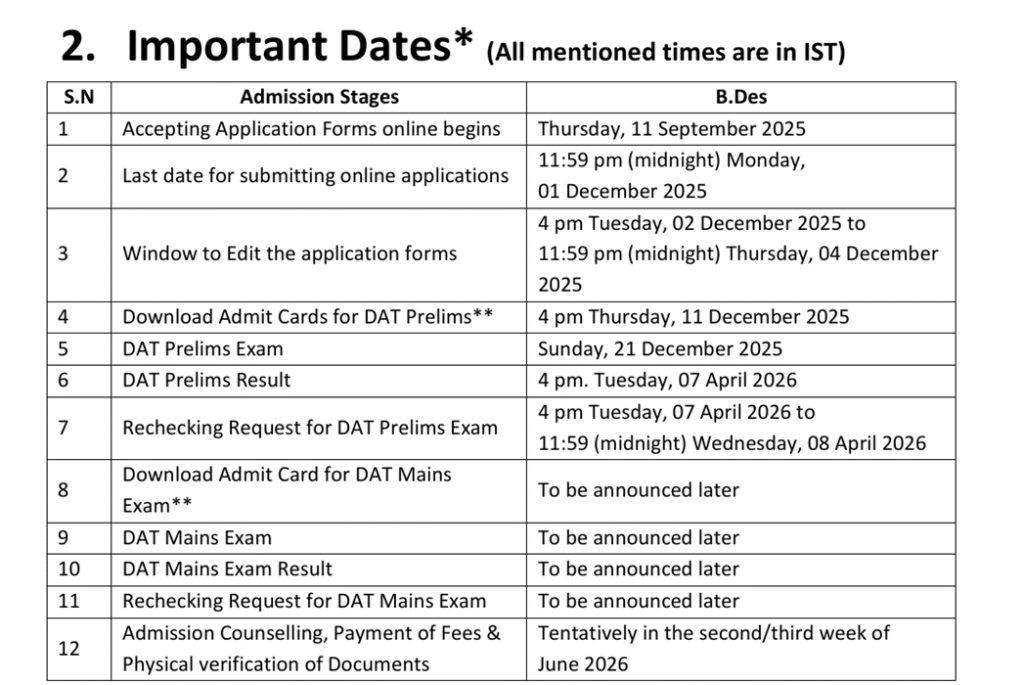
Important Dates 2025-26
Conclusion
The National Institutes of Design (NIDs) aim to nurture creative vision and design-led innovation to shape a better future. For aspiring designers, focusing seriously on the Design Aptitude Test (DAT) is the essential first step toward joining that mission. Focusing on both conceptual understanding and practical application is the key to navigating this unique and demanding selection process.