



20+
Instituions/Organisations Presenting
10
Minutes to Each
LIVE
QnA
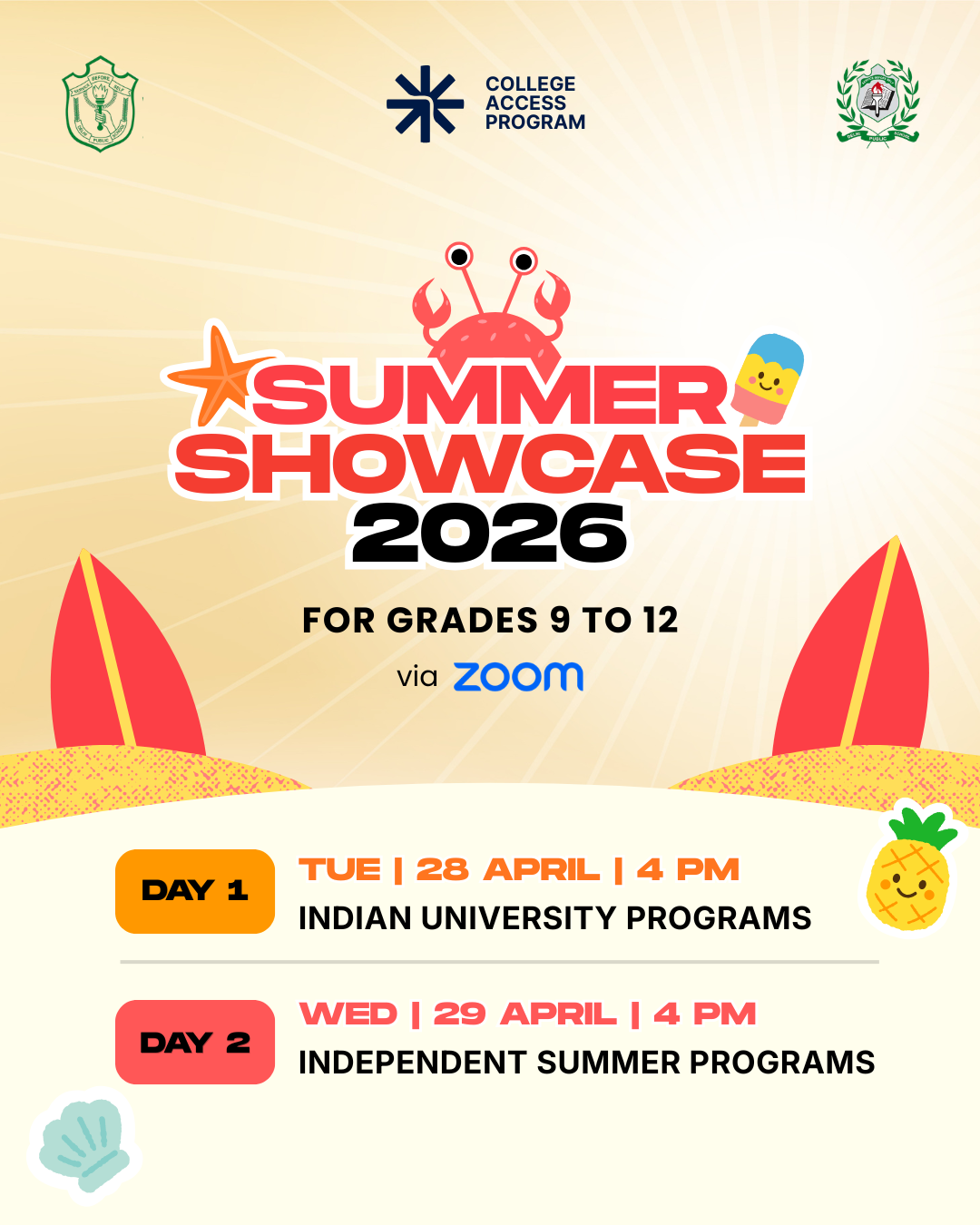
For students of class 9 to 12
Participating Institutions


















Day 1: Indian Summer Programs
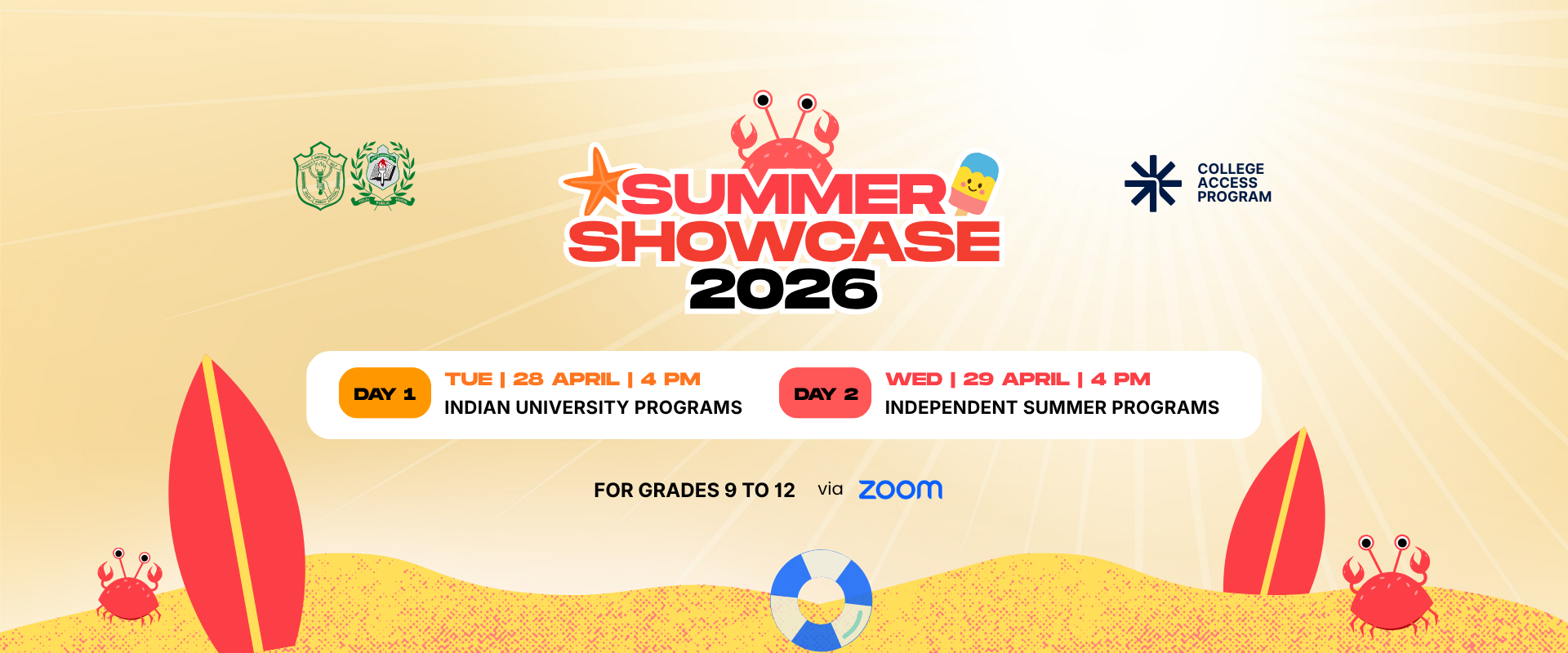
TUE, 28th April 2026 | 4PM
Version: 29 April 2026, 4:30 PM
| University | Time slot |
|---|---|
| Amity University | 4:00-4:10 PM |
| Ashoka University | 4:10-4:20 PM |
| Masters' Union | 4:20-4:30 PM |
| Shoolini University | 4:30-4:40 PM |
| ATLAS SkillTech University | 4:40-4:50 PM |
| Flame University | 4:50-5:00 PM |
| UPES | 5:00-5:10 PM |
| National Law School of India University, Bangalore | 5:10-5:20 PM |
| BML Munjal | 5:20-5:30 PM |
| Shiv Nadar University | 5:30-5:40 PM |
| Narsee Monjee Institute of Management Studies | 5:40-5:50 PM |
| Bennett University | 5:50-6:00 PM |
| Indian School of Hospitality | 6:00-6:10 PM |
| Symbiosis International (Deemed University) | 6:10-6:20 PM |
| Pearl Academy | 6:20-6:30 PM |
Day 2: Independent Summer Programs
WED, 29th April 2026 | 4PM
Version: 29 April 2026, 4:30 PM
| Institution | Time slot |
|---|---|
| Introduction | 4:00-4:05 PM |
| GlobalCert Edu | 4:05-4:15 PM |
| BuildUp | 4:15-4:25 PM |
| Creya Learning | 4:25-4:35 PM |
| Futurowise | 4:35-4:45 PM |
| Intravarsity | 4:45-4:55 PM |
| TribesForGood | 4:55-5:05 PM |
| Youvah | 5:05-5:15 PM |
| Makers' Asylum | 5:15-5:25 PM |
| Omotec | 5:25-5:35 PM |
| RECO | 5:35-5:45 PM |
Your questions answered
Are there summer school programmes available in subjects like Mathematics or Physics?
Certainly. The Amity University Summer School (AUSS) integrates Mathematics and Physics within several advanced, interdisciplinary modules such as Artificial Intelligence, Data Science, Engineering, and Applied Sciences. Rather than treating these subjects in isolation, we emphasize conceptual application, analytical reasoning, and real-world problem-solving, enabling students to appreciate how theoretical knowledge translates into innovation and technology.
What is the eligibility criteria for applying to Amity’s summer school?
The programme is open to students from Grades IX to XII, both from India and internationally. We adopt a holistic and inclusive approach, where selection is not bound by rigid academic cut-offs but rather by:
- Intellectual curiosity
- Willingness to engage in experiential learning
- Openness to interdisciplinary exploration
What is the application process?
The application process has been designed to be seamless and student-centric:
- Students may apply through the official portal of Amity University
- Submission of basic academic and personal details
- Selection of preferred academic track
- Confirmation of participation upon fee payment
Our admissions team remains actively available to guide applicants at every stage.
Is the programme conducted online or offline?
The AUSS is conducted in a fully immersive, on-campus (offline) format. This is intentional, as it allows students to:
- Engage in hands-on laboratory work, simulations, and workshops
- Experience university life firsthand
- Build meaningful peer networks and mentor interactions
What is the total fee, and does it include accommodation and meals?
Course Fees: Rs. 30,000/-
(Inclusive of A/c Hostel and Meals)
– Fully Residential Program at Amity University Noida Campus
– Fees subsidized by Amity Youth Foundation.
The programme follows an all-inclusive residential model. The fee typically covers:
- Academic instruction and learning resources
- On-campus accommodation in secure, well-supervised residences
- Nutritious meals and dining facilities
This ensures that students can focus entirely on learning and personal growth within a safe and structured environment.
What are the key benefits of participating, including the value of the certificate?
Participation in AUSS offers substantial academic and developmental advantages:- Early exposure to university-level pedagogy and research-oriented thinking
- Enhancement of critical thinking, collaboration, and communication skills
- Mentorship from experienced faculty and industry practitioners
- A Certificate of Completion from Amity University, which:
- Adds significant value to undergraduate applications (India and abroad)
- Demonstrates initiative, intellectual engagement, and academic exploration
- Strengthens student portfolios for competitive admissions
Which streams or programmes are suitable for students interested in entrepreneurship? Does it include research or academic writing?
Students inclined towards entrepreneurship can opt for specialised tracks such as:
- Business & Entrepreneurship
- Innovation & Start-up Ecosystems
- Marketing & Management
These modules are designed to go beyond theory and include:
- Case-based learning and business simulations
- Exposure to startup ideation, business models, and market strategy
- Foundational training in research methodologies and structured academic writing, equipping students to articulate ideas with clarity and rigour
Are there any opportunities that can lead to fields like Forensics, Aviation, Marketing, and Psychology?
Yes, AUSS offers focused exposure across diverse and emerging career pathways, including:
- Forensic Science – practical insights into investigative techniques and lab-based analysis
- Aviation – fundamentals of aerodynamics, aviation operations, and industry orientation
- Marketing – branding, consumer psychology, and digital strategy
- Psychology – understanding human behaviour, cognition, and applied psychology
These experiences are curated to provide both conceptual grounding and practical orientation, helping students make informed career choices.
How can the university support students interested in commerce or business careers?
For students aspiring towards commerce and business careers, AUSS provides:
Specialised exposure to Finance, Economics, Business Strategy, and Entrepreneurship
Interaction with academic experts and exposure to real-world business case studies
Insight into future-ready domains such as FinTech, Digital Business, and Global Markets
Additionally, students gain clarity on academic pathways such as BBA, Economics, Finance, and Management, enabling them to make well-informed decisions about their higher education journey.
Which summer programmes would best suit students interested in psychology, AI, politics, philosophy, and writing?
Students can explore these interests through multiple interdisciplinary offerings under the Young Scholars Programme (YSP). Relevant options include:
- Psychology, Behaviour & Well-Being (psychology-focused)
- Tech, Data & Computer Science and Innovators in Science & Tech (AI and technology)
- Policy, Society & International Affairs (politics, philosophy, global issues)
Writing and critical thinking are integrated across programmes as part of Ashoka’s liberal arts pedagogy. Additionally, the Ashoka Horizons Achievers Programme allows students to deep-dive into specific subjects such as psychology, AI, business, and data science through specialised courses.
Are there programmes focused on neuroscience, and can students specialise in that area during the summer?
While YSP offers exposure to psychology and related fields, the Horizons Programme provides more specialised courses such as “The Neuroscience of Well-Being” and “The Memory Lab: From Neurons to Notebooks.” Students can explore neuroscience concepts in depth; however, given the short-term format, the focus is on foundational understanding and exploration rather than full specialisation.
What is the theme and structure of the Horizons programme?
The Ashoka Horizons Achievers Programme is designed as a deep-dive, subject-specific learning experience. It features:
- Interactive, discussion-based sessions
- Small cohorts with personalised attention
- Capstone projects with one-on-one mentorship
- Application of concepts to real-world scenarios
The programme emphasises building strong academic foundations, critical thinking, and 21st-century skills such as communication, problem-solving, and leadership.
Are there programmes related to commerce or business fields?
Yes, both programmes offer strong exposure to commerce-related fields: YSP includes Entrepreneurship, Business & Leadership and Economics, Finance & Markets (Essentials and Advanced tracks).
Horizons offers specialised courses such as Business Strategies for Future Leaders and Founder’s Playbook.
Is the programme available in locations other than Sonipat?
The Young Scholars Programme is a residential, on-campus experience at Ashoka University (Sonipat campus). The Horizons Programme, however, is designed to be more flexible and is typically offered in an online/accessible format for students across locations, allowing participation from India and abroad.
What is the eligibility criteria for different programmes?
For both YSP and Horizons:
- Open to students entering Grades 9–12
- Strong academic interest and curiosity
YSP is selective and immersive, while Horizons focuses on subject-specific exploration with rolling enrolments.
What should students do if they face issues with registration or do not receive responses via email?
Students may reach out directly to the programme teams:
YSP: youngscholars@ashoka.edu.in
YSP Brochure 2026 – https://drive.google.com/file/d/1IDf6CKsMyR-GjGq9_2_QvcFXCxJonZ3a/view
Horizons: horizons@ashoka.edu.in
Horizons Brochure 2026 – https://drive.google.com/file/d/16AVV59x7MLfC8y7kVkvz8MjyrBMNQdjO/view
The respective teams are available to assist with application or technical queries.
How does the university support students in terms of academic growth and career development?
Both programmes are designed to provide:
- Exposure to world-class faculty and industry experts
- Interdisciplinary learning aligned with real-world challenges
- Development of critical thinking and problem-solving skills
- Mentorship and peer collaboration opportunities
- Early insight into academic pathways and career interests
Students leave the programme with greater clarity on subject choices, stronger academic profiles, and enhanced readiness for future college and career decisions.
Where are the programmes conducted (locations), and are online options available?
Currently there are no Online options but we will update you once we formalize the offerings that can be meaningfully built online.
The program for Summer 2026 is available in Hyderabad (https://creyalearning.com/events/the-i3-program), and the schedule has been published. The new cohort schedule for Bangalore will be updated.
What is the duration and schedule, and will it clash with school exams?
The i3 program lasts for 7 days (Monday–Sunday), and the schedules are usually during summer / winter holidays.
How do students work on real-world projects instead of just theoretical learning?
The i3 Program offers hands-on exposure to multiple technology tools, including robotics, IoT, app development and some maker tools like 3D printers and laser cutters. There are no theory classes. The students then try to work on real-world problems and build a prototype to solve them using the tools and time they have available. They will end with a functional prototype.
What kind of skills will students develop (e.g., coding, robotics, problem-solving)?
The students gain exposure to Robotics +IoT ( Microbit / ESP32 / Arduino) + App Dev ( Figma with AI) and to 3D Printers and Laser Cutters. They gain exposure to Design Thinking Frameworks and an Entrepreneurship Mindset. Communication, Collaboration, problem-solving, and creative thinking are built into the experience as students work in groups, design and present their prototype.
Is a certificate awarded upon completion?
Yes, they are awarded a certificate on completion
Can students participate in competitions or advanced projects after the programme?
The students will acquire enough exposure and skills to participate in certain design and prototype competitions. For example, the IIT Madras Junior Makeathon is one competition where they can apply these and many other skills.
Can students already enrolled in other STEM programmes still benefit from Creya?
The i3 Program focuses on integrating multiple STEM skills and design thinking to build a prototype and more importantly the process of journalling and documenting this work to build a portfolio. Students with prior technology exposure have attended and benefited as they can go to the next level.
Do these programmes happen throughout the year?
The i3 Program is usually planned for summer and winter. But specific camps can be arranged if enough students from a school show interest.
How are your programmes structured (mentorship, internships, or guided projects)?
Our programmes are primarily structured around guided projects with strong mentorship. Students are mentored by industry experts, researchers, and professors from leading universities. Each student receives personal attention, regular feedback, and one-on-one guidance throughout the programme. By the end, students complete a high-quality project, and we also support them in publishing their work, which adds real value to their academic profile.
Can students participate alongside regular school schedules?
Yes, students can easily manage this alongside school. We conduct only three sessions per week, all scheduled in the evening, so they do not clash with school hours.
What happens if school holidays end early? Can students continue remotely?
Yes, students can continue fully remotely without any disruption. Our programmes are designed to be flexible, so even if school schedules change, students can stay on track with sessions, mentorship, and project work online. Additionally, we offer multiple cohorts, so if there is a scheduling conflict, students can be shifted to another cohort to ensure they do not miss anything important.
How does this programme support applications to top global universities?
The programme strengthens university applications in multiple ways. Students receive a certificate of completion, but more importantly, they build and often publish their own projects, showcasing initiative, research skills, and subject depth. The skill-based learning approach also helps students develop strong fundamentals, preparing them for university-level academics and helping them stand out in competitive applications.
What kind of career exposure and mentorship do students receive?
Students gain direct exposure to real-world career paths through mentorship from professionals working in their fields of interest. They learn how concepts are applied in industries, explore career options, and receive practical guidance on skills, portfolios, and future pathways. This enables them to make more informed academic and career decisions.
Are there different tracks for STEM, business, or humanities students?
Yes, we offer different tracks tailored to students’ interests, including STEM, business, and humanities. Each track is designed with relevant projects, mentorship, and learning outcomes, ensuring students gain deep, focused knowledge in their chosen field.
Are the NUS/NTU summer programmes conducted online, offline, or hybrid?
Our programs are generally offline (in-person) or hybrid.
What does a typical day at the programme look like?
Students spend their first half of the day engaged in training sessions by the professors. Post lunch, the students will have either activities like group discussions or planned tours.
What subjects or tracks are offered (e.g., AI, business, engineering), and can students choose specialisations?
Courses in the field of Business, AI, Tech, Entrepreneurship, Business Psychology etc. are present.
Are there any prerequisites, or are beginners also accepted and trained from scratch?
Students are trained afresh, with no requirements for prior knowledge of the topic.
Does this programme include research, internships, or project-based learning?
Yes, the students will be undergoing project-based learning and, in a few courses, internships with us.
Will participation strengthen my university application (e.g., for Ivy League, NUS, or NTU)?
Our courses at NUS, NTU etc. have a Assessment Report along with the certificate of completion, which substantiates the students’ abilities and thus, securing a Distinction or Merit is beneficial as part of their application to universities.
Are certificates or Letters of Recommendation provided, and how valuable are they?
Yes, LOR’s/ Commendation Letters are provided to students. From our past record, students receiving LOR’s have generally got admits into Top 100 universities.
Are there merit-based scholarships or financial aid options available?
Merit/ Interview-based Scholarships are available at times.
How and where can students apply?
Students can reach out to us on www.globalcertedu.com
What kind of mentorship, networking, or global exposure will students gain?
We strive to provide a holistic experience to students, which promotes skill-based practical learning, learning through exposure, which helps them grow academically and personally with our carefully selected partner universities globally.
- What is the application process, and where can students register? The application process is straightforward. Students can register directly using this form: https://forms.gle/8e1CJBbVzrUMs9HK7
- Are internships conducted online, offline, or hybrid? All of our internships are conducted 100% online.
- Can students take up multiple internships, or only one at a time? Yes, students are welcome to take up multiple internships if they wish to explore different fields simultaneously.
- What domains are available (e.g., AI, aerospace, law, psychology, entrepreneurship)? We offer a wide variety of domains, including: AI & Machine Learning, Astrophysics, Aerospace Engineering, Mechatronics, Law, Psychology, International Relations, Business, Economics, Entrepreneurship, Finance, Marketing, Biology, and Social Impact.
- What prior knowledge or skills are required for participation? There are no prerequisites required. These programs are designed to accommodate beginners and help students learn from the ground up.
- What kind of projects will students work on (e.g., aerospace simulations, AI models)? Students will work on practical, real-world projects directly related to the current operations and goals of their host companies.
- Are there safety protocols in technical fields like aerospace or hardware-based projects? Because all of our internships are entirely virtual, physical safety protocols are not required.
- How does mentorship work, especially for beginners with no prior exposure? We hold live mentorship sessions every Sunday. During these sessions, industry mentors provide students with all the necessary resources, training, and guidance to successfully complete their weekly internship tasks.
- How will this internship help build a strong portfolio or career pathway? These internships allow students to experience a specific career path firsthand by working on real-life projects alongside active industry professionals. Upon successful completion, students receive an internship certificate and a Letter of Recommendation (LOR) from their host company, both of which are incredibly valuable additions to college portfolios and future resumes.
- What are the internship dates, duration, and deadlines? I am interested in the UP government internship The UP Government internship with the MLA office is a 4-week program. We have two cohorts available: the first cohort starts on May 15th, and the second cohort starts on June 15th.
- Till when is the discount available for DPS students? For DPS students, all programs are available at a special flat price of ₹6,000. This offer is valid until May 10th.
What kind of maker or innovation programmes are available for students to explore?
Innovation School by Maker’s Asylum is a unique hybrid program designed specifically for teens (13+) to dive into pre-engineering, design, and STEAM skills through hands-on projects. The goal is to empower young makers to get their hands dirty & bring their ideas to life. The program now has students from over 20 countries and 50 cities in India. The program has 3 parts as follows and has a unique online and offline structure making it accessible to anyone.
- Skill Building (Online 1:1 + Hardware Kits Shipped Home) – 50 hrs of pre-engineering, design & tech learning
- Pre-residency Mentorship (Online Group) – refine ideas with mentors worldwide
- Residency (7 days in person) – build prototypes using real tools
Please note that the program intake is application based and has two cycles of intake – Summer & Winter. As the program requires pre work before coming to the physical residency, hence the application process starts almost 6 months before the actual residency dates.
- You can check our Founder’s note on the program here LINK
- Program Brochure : LINK
- Application form : LINK
- Get in touch with our team to learn more : LINK
One can also start with small maker skills and then upgrade to the Innovation School program.
Are there upcoming programmes in cities other than Goa?
We will be hosting the residencies in Summer 2027 in Goa at Maker’s Asylum, New York at Cornell Tech and Barcelona at IAAC
What skills can students develop (e.g., prototyping, design thinking, fabrication)
- Design Thinking & Innovation — learning how to identify problems, brainstorm solutions, prototype ideas, and iterate based on feedback.
- Creative Problem Solving — approaching challenges with curiosity, experimentation, and systems thinking.
- Digital Fabrication & Making — hands-on exposure to tools and technologies such as 3D printing, laser cutting, electronics, CAD design, and rapid prototyping.
- AI & Emerging Technologies — understanding and applying tools like AI, coding, automation, and digital workflows in meaningful ways.
- Entrepreneurial Thinking — developing ideas into viable products, experiences, or ventures with an understanding of impact and feasibility.
- Collaboration & Teamwork — working in multidisciplinary teams, communicating ideas, and building collectively.
- Communication & Storytelling — pitching ideas, presenting projects, documenting processes, and building portfolios.
- Confidence & Leadership — taking initiative, learning by doing, and becoming comfortable with experimentation and uncertainty.
- Research & User Empathy — understanding people’s needs through observation, interviews, and human-centered design approaches.
- Adaptability & Independent Learning — learning how to learn, explore new tools quickly, and navigate an evolving future.
Beyond technical skills, Innovation School encourages students to become makers, thinkers, and changemakers who are capable of turning ideas into meaningful real-world outcomes.
How can students stay in touch for future workshops or programmes?
Please fill this form out so that our team can keep you in loop with all the information LINK
Are there seasonal programmes (e.g., winter/summer camps), and what do they include? No. The Innovation School is our starting program for teens to understand the whole journey of making, post which they can do more with 1:1 capstone mentoring, international residencies, and even joining our hardware startup incubator.
Will building a project help me in college admissions?
Absolutely — building projects and maker portfolios can play a powerful role in college admissions today.
At Innovation School, students create hands-on projects that become part of a maker portfolio — a collection of experiments, prototypes, research, documentation, and real-world problem-solving work that reflects who they are as learners and creators.
A strong maker portfolio helps students:
- Show, not just tell — instead of only listing achievements, students demonstrate what they can build, design, prototype, and think through.
- Stand out in applications to universities that value creativity, initiative, interdisciplinary thinking, and hands-on learning.
- Build evidence of skills across areas like innovation, design, engineering, technology, sustainability, storytelling, and entrepreneurship.
- Showcase their process, not just final outcomes — including ideation, failures, iterations, and learning journeys.
- Strengthen college essays and interviews with authentic project stories and experiences.
- Develop a unique narrative around their interests and future goals.
Many leading universities today appreciate applicants who have pursued independent projects, built tangible solutions, explored community impact, or experimented beyond the classroom. A maker portfolio gives students a way to present these experiences in a meaningful and visual format.
At Innovation School, we focus not only on helping students build projects — but also on helping them document, present, and communicate their work effectively through portfolios, presentations, and storytelling. Attached is our research on how maker portfolios are becoming an important part of admissions.
Are there any programmes specifically focused on Mathematics or quantitative skills?
We have U18 internships here, wherein there is a specific track for students interested in finance. These are internships for high school students for 5 weeks. First two weeks, it’s basics 101 across business, marketing, finance and technology. End of week 2 students pick one track. In finance track (CFO – track), students will work on building a live portfolio dealing with financial markets and this will involve analyzing stocks and quantitatively allocating capital to stocks.
Is the summer programme competitive in nature? Can we balance it with school?
Yes, it is competitive in nature. Summer boot camps (Skills week and Startup week) are 5-days. Winners and top performers are identified during the week and hence this would need students’ presence from 9 AM to 4 PM. However, we have U18 internships – it is a 5-week program. Quite competitive, this would allow students to spend 3 hours per day on weekdays. Balancing with school can be done as we will provide recordings and mentors would stay connected
Does the programme include mentorship and guided learning before independent work? Yes, it will be supported by a team of Masters’ Union student mentors. Our Student mentor to student ratio is 10 students to have 1 student mentor. These mentors would have already started to build their startups, and have extensive experience imparting knowledge to young curious minds.
Are the programmes available online, offline, or both?
U18 Internships is purely an online program (25th May – 28th June). Summer boot camps are purely offline.
What is the fee structure, and are there lower-cost or scholarship options available? Yes, there is a merit-based scholarship available for students and is dependent on case-to-case basis based on the interest levels. Summer boot camps cost Rs. 44,999 per person and in a group of 4+ costs Rs. 34,999. U18 Internships costs Rs. 89,999 per person.
How does the university support students interested in commerce or business careers?
All our summer programs have specific segments for students interested in commerce / business careers. Summer boot camps – 2nd edition is Summer Startup week (24-28 June). In this, students end up building an MVP and start with their startup and pitch to real investors. We have multiple masters taking sessions on the way to think about building a startup and we share frameworks which is a great starting point. On the other hand, we have U18 internships. One of the tracks is to become a Chief Business Officer (CBO) – Here students build a startup and will launch their own e-commerce venture.
What are the key academic and career benefits of attending the programme?
Attending these profile-building programs are one way of showcasing the effort put in to demonstrate real skill and a portfolio of work. Benefits are, students will have a certificate, an LOR and outcomes that can be spoken about in college applications.
How is this programme different from traditional learning or competitions?
We follow learning by doing as a philosophy – Students will learn things by practically applying the learnings. This is a stark differentiating factor across all our profile-building programs for high school students.
What is the frequency and duration of classes?
Sessions are 60 minutes long. They can be scheduled once or twice a week. A customized schedule is developed based on the student’s availability.
What is the eligibility criteria (age/grade requirements)? Can younger students (middle school) also participate?
Students in grades 8 to 12 can’t participate in the course. Besides a genuine interest in learning and a dedication to the reading, writing, and critical thinking process, we have no other eligibility criteria.
Will this programme help students in IB or international curricula?
Absolutely! Students in the IB or international curricula will read texts including the highest-quality scholarly publications, which are very different from those assigned in school.
Can students with basic English skills still apply and succeed?
Absolutely. Students with any level of English can apply as long as they are interested in reading texts written in English and writing in English.
What kind of academic or skill outcomes can students expect?
Students can expect to improve their reading comprehension skills, speed of reading, critical thinking abilities, writing skills. Students will also leave with deeper scholarly knowledge about the specific topic that they explore through the course.
- What is the eligibility criteria for the Patent programme?
Ans – Any student keen for research from Classes IX to XII can apply. A research mindset & keenness to learn is the only eligibility. - I don’t have any background in this field, can I still apply?
Ans – Yes if you are keen on learning the basics of Intellectual Property in India and are interested in knowing how research is done you should definitely apply. - What is the total cost of the programme (including online and offline options)?
Ans – There is one way this programme works. Application Fee- 1000 followed by 2 Virtual Research Initiation Workshops followed by a jury and after being shortlisted the program fee is 30,000. The IP filing charges vary from 7-10k. Making the entire fee about 40k - Is accommodation provided?
Ans – Yes its a residential program after shortlisting. - Can you share more details about the Patent School?
Ans – Yes you can visit https://www.ideasthatmatter.in/summer-patent-school/ - Could you provide an official contact number or support channel for further queries?
Ans – Yes you can drop an email at vinmre@shooliniuniversity.com or WhatsApp at 6239614060 - What is Shoolini University known for?
Ans – Founded by leading academicians and professionals, Shoolini University is a young, research-focussed, philanthropic university. Established in 2009, this dynamic and innovation-led centre of learning has made giant strides. It has consistently been ranked among India’s top 100 universities (NIRF), is one of India’s highest generators of patents and innovation, and matches the world’s best universities in research output.
Are there any summer programmes related to medicine or pre-med exposure?
The existing programme will cover medicine like any other discipline
What fields within healthcare or life sciences are covered?
Possibly medicine, para-medical technology, radiotherapy, behavioural health sciences, biotechnology, biochemistry, assisted reproduction technology & embryology, hospital & healthcare management, nutrition & dietetics, nursing, physiotherapy, public health
What is the eligibility criteria for such programmes?
Grade ix-xii
Are the programmes practical (lab exposure) or theory-based?
Introduction (including career path, required skill set) + demonstration during lab visits
What career pathways can these programmes support?
None
Does symbiosis offer any online programmes for high schoolers other than the summer school?
No
Are there any programmes offered in areas like journalism, storytelling, or dance?
Journalism & Communications: Yes, we offer programmes that empower budding journalists to use investigative thinking and storytelling to address real-world social impact challenges at the intersection of journalism, law, and finance. Students explore issues such as the gender pay gap, aiming to build awareness, inform the public, and inspire action towards a more equitable society. You can read here https://www.tribesforgood.com/featured-projects
Dance & Performing Arts: Dance is used as a tool for social change, combining physical movement with mental well-being. Through this programme, students use arts as a tool to simplify and teach concepts, while also building confidence and emotional expression.
Drama and movement-based storytelling also create spaces for empathy, allowing individuals to share experiences and engage with issues like mental health in a meaningful way.
Where are the offline fieldwork locations?
Offline fieldworks are conducted across Delhi, Mumbai, Bangalore, and Kolkata.
What kind of real-world exposure will students get during fieldwork?
Students work directly with communities to design and implement interventions across sectors such as technology, finance, health, and more.
A Grade 11 student, Yuti, collaborated with women artisans to explore a key gap in India’s craft economy—not just production, but ownership. Through a women-led creative enterprise model, she reimagined jewellery-making as economic participation:
A bracelet becomes a product
A phone becomes a distribution channel
A name becomes a brand
This shifted the focus from skill-building to ownership, visibility, and financial agency, while also addressing deeper perceptions around money and value. Explore her project in detail here:https://www.tribesforgood.com/blogs/view/beads-stories-and-the-business-of-believing-in-yourself
- Are there programmes focused on communication and public speaking?
Yes, these are skills built-in the program, as students work directly with the communities and at the end of the program they also showcase their work to us through a short pitch at graduation.
- What skills will students develop?
Students gain deeper knowledge in fields like economics, policy, STEM, and community engagement. While also building a strong foundation in areas such as communication, leadership, and social impact.
- If I already have an idea or cause I resonate with, can you guide me on how to create impact?
Absolutely! We’d be happy to support your Changemaking journey, feel free to book a complimentary discovery call with us.
- What is the benefit of social entrepreneurship?
Social entrepreneurship enables individuals to explore their ideas at a deeper level and translate them into meaningful, real-world interventions. It fosters problem-solving, ownership, and the ability to create sustainable impact.
- What are the different tracks offered in the summer school (e.g., AI, Aerospace, Humanities), and can students choose their preferred domain?
Student can choose one from any of these – 1)Computer Science and AI 2) Social Sciences and Humanities 3)Aerospace and Aeromodelling.
- What is the structure of the programme, how much time is spent on academics vs activities like sports, projects, and campus life?
The program is structured in a way that all academic activities consist of workshops and hands-on modules. Every domain has its own projects and all domains are linked with startup pitch. The sports are scheduled in the evening, with one small jungle trek early in the morning.
- Is the programme fully residential, and what facilities (accommodation, meals, safety, medical support) are provided on campus?
It’s fully residential. Rooms will be two/three sharing. 4 meals a day. UPES has all safety equipment and medical facilities on campus.
- What skills will students develop during the programme (e.g., coding, problem-solving, communication, teamwork)?
Coding, AI & Machine learning, Data Science, psychology, economics, career exploration, aerodynamics and aeromodelling, entrepreneurship and startups.
- What kind of projects or hands-on experiences will students work on (e.g., AI models, rockets, group projects)?
AI models, AI games, AI projects, glider making, rocket testing, startup pitch in group.
- What is the total fee, and does it include accommodation, meals, and all activities?
The fee is 25,000 + GST including the program fee+ stay+ food. It doesn’t include local transport.
- How does this summer school help students explore career paths and make better subject/college decisions?
The summer school is designed in a way that students learn life skills and entrepreneurship along with exploring choice of domains to get first hand experience of what the career and subjects look like. Interaction with faculty members, trainers and peers will help them understand the subjects so that they can make informed decisions.